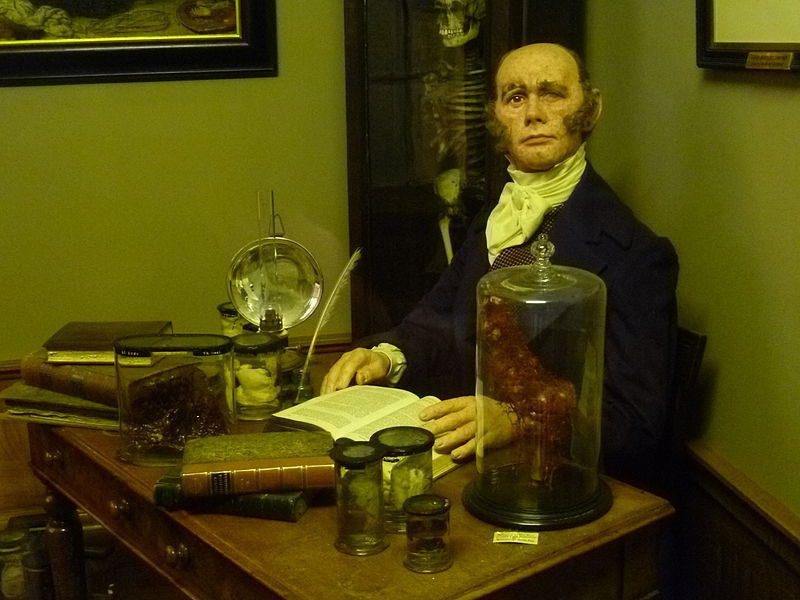

Robert Knox gained notoriety as an eccentric doctor, surgeon, and naturalist.
Iedinburgh will tell you more.
He became most famous because he bought dead bodies. Yes, you read that correctly. The surgeon bought the corpses of deceased people in order to use them later for teaching his students. He even had his own “suppliers” for this purpose.
But let’s start from the beginning.
Early Years
The future surgeon was born in Edinburgh. After graduating from the Royal High School of Edinburgh, Knox enrolled at the University of Edinburgh to study medicine.
Interestingly, university archives indicate that Knox initially had difficulty passing his anatomy exam.
However, as it’s often said, if you truly desire something, everything around you begins to facilitate its realization. Medicine was Knox’s dream, and despite his difficulties with anatomy, he managed to join the private anatomy class of the renowned British anatomist and physician John Barclay. This eventually led to his success, and he finally passed his anatomy exam.
The Start of His Practice
After graduating from the University of Edinburgh in 1814, Knox began practicing medicine. His first role was at St Bartholomew’s Hospital in London, where he assisted a military surgeon.
In 1815, towards the end of the Napoleonic Wars, Robert worked at a military hospital in Brussels. This period proved decisive for his career, as it inspired his determination to advance the study of anatomy. He wanted to improve his skills in performing surgical operations.
To pursue this idea, in the spring of 1817, Knox joined the 72nd Highland Regiment and travelled with them to South Africa.
He remained there for a considerable time, only returning to London shortly before Christmas 1820. In 1821, he travelled again—this time to Paris, where for over a year he enhanced his knowledge of anatomy.
Interestingly, it was in Paris that Knox found figures he considered his idols—Georges Cuvier and Étienne Geoffroy Saint-Hilaire.
Return to Edinburgh
Having completed his anatomical studies, Knox returned to Edinburgh in 1822.
In 1823, he was admitted to the Royal Society of Edinburgh. Interestingly, that year Knox mostly devoted his time to writing articles. Surprisingly, these focused not on human anatomy or surgery, but zoology.
However, after joining the Royal Society, Knox once again established himself as a progressive surgeon.
Before the Royal College of Surgeons of Edinburgh, he proposed the creation of a Museum of Comparative Anatomy. Knox’s idea gained support, and within eight months, he became director of the newly founded museum.
Unusual Teaching Methods
Teaching was another sphere of Robert Knox’s self-realization.
From 1826 to 1840, students at John Barclay’s anatomy school had the privilege of attending Knox’s lectures. Unlike many colleagues, Robert’s classes were interesting and engaging. However, these lectures sometimes contained information that genuinely shocked the students.
The surgeon loved overly detailed anatomical descriptions, and occasionally used his classes to express ironic criticisms about religion and the clergy.
“The Corpse Buyer”
As mentioned earlier, Knox gained widespread fame for purchasing dead bodies. This gained such notoriety that it not only brought him fame and countless media mentions, but also inspired one of Robert Louis Stevenson’s stories.
But let’s first provide some context.
In 1815, medical curricula throughout Great Britain significantly expanded anatomy studies. Before the Anatomy Act of 1832, medical institutions obtained bodies only of executed criminals. This was the sole legal method for obtaining cadavers for teaching.
However, at the start of the 19th century, the Bloody Code was abolished, significantly reducing executions. As a result, there was a severe shortage of bodies, making normal medical education nearly impossible.
Under these circumstances, it became common practice for doctors to illegally purchase bodies of vagrants who had already been buried or those who had died on the streets. But this practice did not satisfy Knox. His teaching was based on the “French model,” which required one cadaver per student.
Then Knox’s “difficult situation” resolved itself, almost automatically.
In the autumn of 1827, a tenant of William Hare, who rented accommodation, passed away. Knox offered to purchase the body. This event initiated the “body business.”
Hare, along with his accomplice Burke, began murdering drunkards and homeless individuals in order to sell their corpses to Knox.
They managed sixteen murders before their arrest on November 2, 1828. Naturally, the “cooperation” between the surgeon and criminals was quickly uncovered. However, Hare and Burke insisted that Knox did not know the bodies had been deliberately murdered at the time of purchase.
Sad Consequences
The story created genuine panic and fear throughout the city, further intensified by numerous newspaper publications.
All this irreparably damaged Knox’s reputation, despite the fact he faced no formal charges.
The public began fearing him, and his home became the target of attacks.
The Royal College of Surgeons, where Knox was still employed, desperately tried to remove him. In the summer of 1831, Knox was forced to resign as director of the Museum of Comparative Anatomy, a museum he himself had founded.
However, these sad events did not stop Knox. He continued illegally purchasing bodies and offering private anatomy lessons.
But his activities completely declined after the Anatomy Act of 1832. This act legally permitted anatomy classes at medical universities, providing several legal ways to obtain cadavers. Thus, medical institutions began legally acquiring bodies for anatomy studies.
Relocation and End of Career
In 1841, Knox’s wife Mary Russell (whom he married in 1823) and one of their children passed away. These tragic events, combined with persistent public persecution, forced Robert to relocate to London. Yet, his notoriety soon followed him there, making it impossible to find professional employment.
To earn a living, Knox became a medical journalist, writing articles and books, and occasionally conducting public anatomy lectures.
His final place of employment was a cancer hospital in London, where he worked as a pathologist.
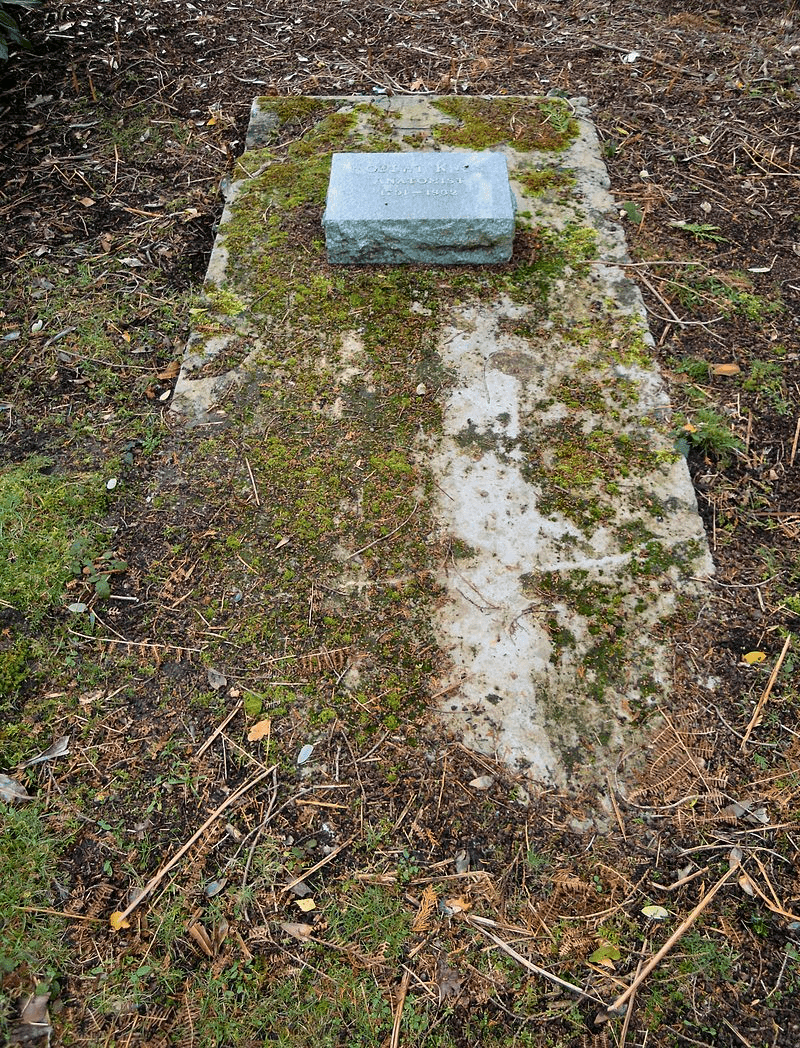
The life of the infamous surgeon ended on December 20, 1862. Robert Knox’s grave is located at Brookwood Cemetery.